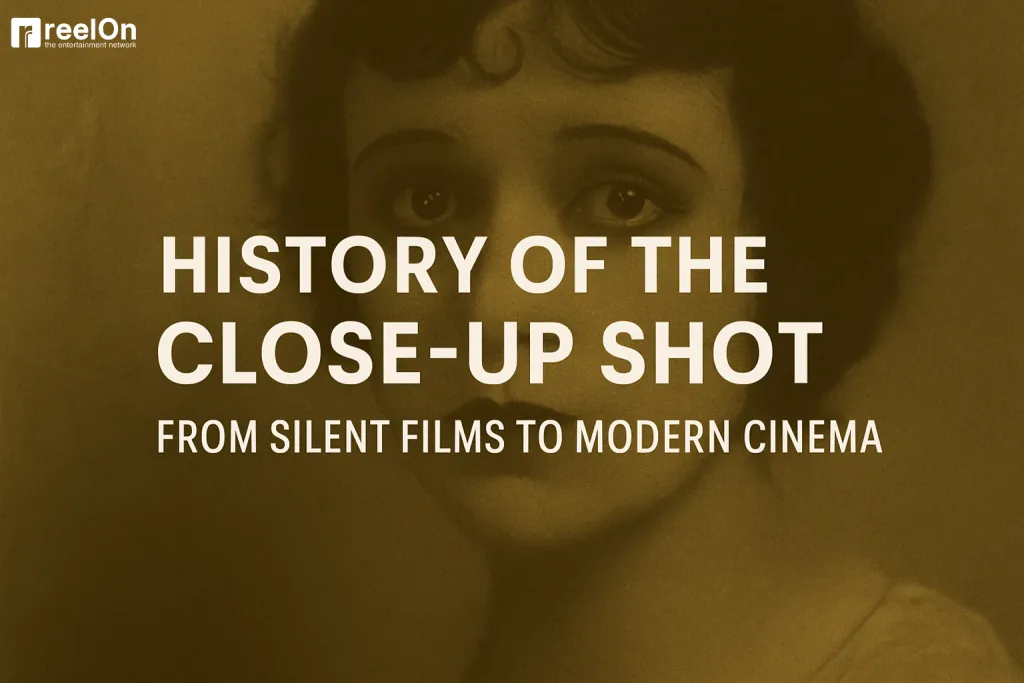
History of the Close-Up Shot: From Silent Films to Modern Cinema
Cinema has always been a conversation between image and emotion. Few tools express that relationship better than the close-up shot the moment when the camera dares to move closer, stripping away the world and focusing entirely on a human face, a gesture, or an object that carries meaning.
Today, close-ups are everywhere from YouTube videos to Hollywood blockbusters but their origins trace back to the earliest days of filmmaking. At reelOn, we believe understanding the evolution of the close-up is key to mastering cinematic language itself.
The Birth of the Close-Up (Late 1800s – Early 1900s)
In cinema’s infancy, filmmakers were still discovering the language of visual storytelling. Early films were shot like stage plays wide and static, with the camera observing from a distance.
Then came innovators like Georges Méliès and Edwin S. Porter, who began experimenting with framing. Porter’s The Great Train Robbery (1903) featured one of cinema’s first iconic close-ups a bandit firing his gun directly at the camera. It shocked audiences, proving that emotional impact could come from proximity, not just spectacle.
This marked a turning point: filmmakers realized that moving closer didn’t just change perspective it changed storytelling itself.
Try reelOn - Entertainment Networking Platform
D.W. Griffith and the Emotional Revolution (1910s)
Director D.W. Griffith revolutionized narrative cinema by giving emotion a central place in filmmaking. In The Lonedale Operator (1911), Griffith used close-ups of a woman’s terrified face and a wrench mistaken for a gun to build suspense and empathy.
For the first time, the audience wasn’t just watching characters they were feeling with them. The close-up became a window into psychology, turning cinema into an emotional art form rather than a visual novelty.
The Silent Era: Expression Through Faces (1920s)
Without spoken dialogue, silent films relied heavily on visual emotion. Actors developed subtle facial expressions designed for the camera, and directors used close-ups as punctuation moments of heightened emotion amidst broader scenes.
Charlie Chaplin mastered the expressive close-up, making audiences laugh or cry with a single glance.
Sergei Eisenstein, in Soviet montage theory, used close-ups rhythmically to evoke emotion and political energy.
By the late 1920s, the close-up had become a universal cinematic language.
The Sound Era: Voice Meets Visual (1930s–1940s)
The arrival of synchronized sound changed everything. Now, actors could rely on dialogue and tone rather than exaggerated gestures. Close-ups became more natural, intimate, and psychological.
Hollywood filmmakers began using them to punctuate drama and romance:
Greta Garbo’s luminous close-ups embodied mystery and melancholy.
Ingrid Bergman in Casablanca showed how close-ups could immortalize longing and loss.
Lighting and makeup evolved to suit close framing, and cinematographers learned to sculpt emotion with shadow and highlight.
The Golden Age of Hollywood: Glamour and Power (1950s–1960s)
During this era, close-ups became icons of movie stardom. The lens celebrated faces as symbols of beauty, desire, and charisma. Directors like Alfred Hitchcock, however, used them with precision and purpose.
In Psycho (1960), Hitchcock weaponized the close-up, using it to both hide and reveal horror. Meanwhile, directors like Kurosawa and Bergman explored close-ups for existential and spiritual depth, emphasizing thought and silence over glamour.
The New Wave and Realism (1960s–1970s)
The French New Wave and Italian Neorealism broke the rules. Filmmakers like Jean-Luc Godard and Federico Fellini used handheld close-ups to create realism and spontaneity.
Faces weren’t perfectly lit anymore they were raw, sweaty, and real. This period democratized the close-up, turning it from a symbol of stardom into a tool for truth.
Breathless (1960): handheld close-ups brought intimacy and chaos.
The Seventh Seal (1957): close-ups became meditations on mortality.
Modern Cinema: Intimacy, Chaos, and Precision (1980s–Today)
With the rise of digital cinematography, filmmakers gained freedom. Lightweight cameras and high-resolution sensors made it easier than ever to explore proximity.
Martin Scorsese used extreme close-ups for psychological tension (Taxi Driver, Raging Bull).
Terrence Malick and Denis Villeneuve used soft, natural light to turn close-ups into moments of reflection.
Greta Gerwig’s Lady Bird and Little Women employ delicate close-ups to highlight emotional honesty.
In the digital era, the close-up is no longer just emotional it’s immersive. Modern filmmakers mix shallow focus, lens flare, and subtle camera motion to create a feeling of “being there.”
The Future: Emotional Realism in Every Frame
Today, close-ups are not limited to the cinema. They dominate online storytelling short films, vlogs, and reels. The human face remains the most expressive subject, and filmmakers continue to find new ways to capture emotion through light, movement, and technology.
The next frontier lies in virtual production and AI-assisted cinematography, where digital characters can express nuanced emotions as powerfully as live actors. But no matter how the medium evolves, the essence remains: the close-up connects us.
Final Frame
From the silent stare of a 1910s heroine to the trembling eyes of a modern protagonist, the close-up shot has remained the heartbeat of cinema. It has evolved with technology, yet its purpose is timeless to reveal what words cannot say.
For more guides on cinematic language, visual storytelling, and filmmaking techniques, explore reelOnApp platform for filmmakers, creators, and storytellers.
FAQs
What is a close-up shot?
A. A shot that tightly frames a subject, usually the face, to convey emotion and detail.When was the first close-up used in film?
A. Around 1903, in The Great Train Robbery by Edwin S. Porter.Who popularized emotional close-ups?
A. D.W. Griffith, through films like The Lonedale Operator.How were close-ups used in silent films?
A. To communicate emotion visually, since dialogue didn’t exist.Why did lighting evolve with close-ups?
A. Because tighter framing required careful light control for clarity and expression.How did Hitchcock use close-ups differently?
A. He used them for suspense, symbolism, and psychological tension.What impact did digital cameras have on close-ups?
A. They allowed greater flexibility, realism, and intimacy.Are close-ups overused in modern cinema?
A. Sometimes when used without purpose, they lose emotional impact.What defines a great cinematic close-up?
A. Emotional truth, intentional framing, and synergy between actor and light.Why do audiences respond so strongly to close-ups?
A. Because they mirror real human connection eye contact, emotion, and empathy.

