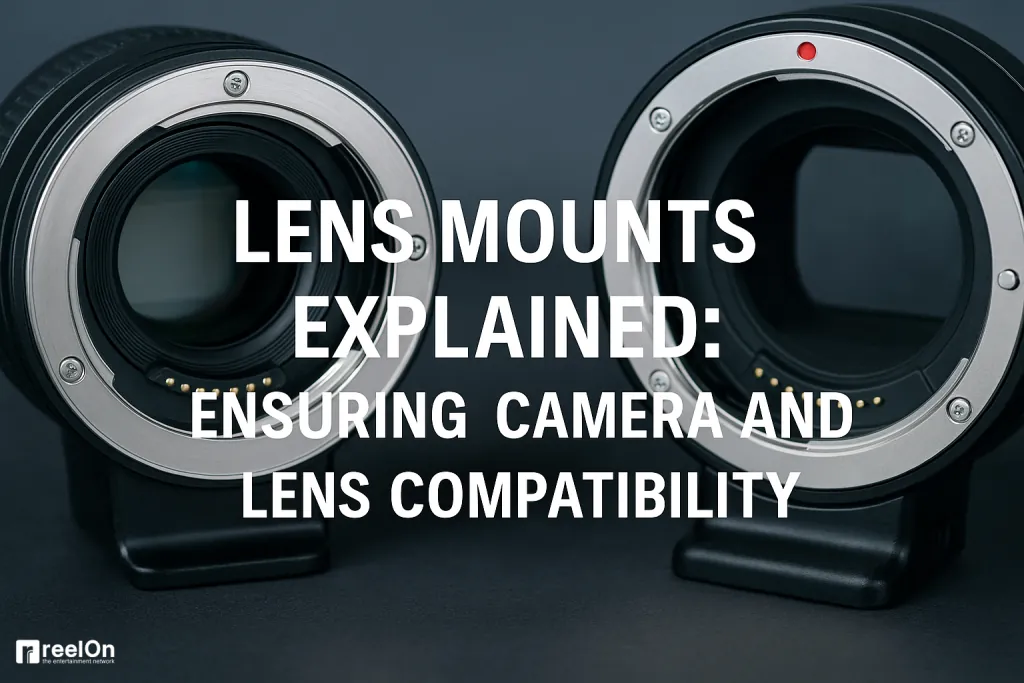
Lens Mounts Explained: Ensuring Camera and Lens Compatibility
Opening Shot
When you think about cinematic visuals, lenses are often the stars of the conversation sharpness, flares, bokeh, or character. But before any of that can matter, there’s a crucial first step: the lens has to fit the camera. This is where lens mounts come in. They’re the handshake between lens and body, the unseen mechanism that determines compatibility, performance, and creative freedom. Ignore mounts, and you risk being locked into a limited system. Understand them, and you unlock endless possibilities. To explore more about filmmaking tools and connect with a community of creators, visit reelOn
End-to-End Explanation
1. Defining the Lens Mount
At its core, a lens mount is the mechanical and electronic connection between the lens and the camera body. It has two key roles:
Physical Alignment: Making sure the lens sits at the correct distance (flange focal distance) from the sensor.
Data Communication: Allowing the camera and lens to “talk” (aperture control, autofocus, stabilization, metadata logging).
2. The Big Players in Lens Mounts
Canon EF (DSLR Standard): Legendary for decades, supported by countless third-party lenses.
Canon RF (Mirrorless Future): Designed for shorter flange distance, advanced optics, and faster communication.
Nikon F: A long-standing mount that powered Nikon DSLRs.
Nikon Z: Mirrorless innovation with ultra-wide mount diameter.
Sony E: Hugely popular in hybrid filmmaking compact and versatile.
L-Mount Alliance (Panasonic, Leica, Sigma): Collaborative standard for full-frame mirrorless.
Micro Four Thirds (MFT): Shared by Panasonic and Olympus, great for compact filmmaking.
PL Mount: The cinema industry workhorse, used by ARRI, RED, and other major players.
Try reelOn - Entertainment Networking Platform
3. Why Flange Focal Distance Matters
The flange focal distance (FFD) is the measurement from the lens mount to the image sensor.
Shorter FFD = more adaptability (mirrorless cameras can use more legacy glass).
Longer FFD = fewer options without optical adapters.
This explains why Sony E-mount cameras can adapt Canon EF lenses, but the reverse is nearly impossible without image-degrading glass.
4. Adapters: The Bridge Between Worlds
Adapters are lifesavers for filmmakers who want flexibility. Examples:
Canon EF → Sony E (with smart adapters like Metabones for autofocus).
PL → Mirrorless (for cinema glass on compact bodies).
Vintage Lenses → Modern Digital (M42, Leica R, Minolta).
⚠️ Caution: Not all adapters maintain electronic communication, and cheap ones may cause misalignment or image softness.
5. Cinema-Specific Needs
In filmmaking, stability is everything. Cinema lenses are heavy, and mounts must endure repeated changes. That’s why:
PL Mount (Positive Lock): Uses a twist-lock mechanism, reducing wobble and ensuring perfect focus accuracy.
EF Cinema Standard: Widely used because of its ecosystem, but less robust than PL.
6. Mount Ecosystems and Future-Proofing
When you pick a camera system, you’re really picking a lens ecosystem:
Canon RF promises advanced optics, but third-party lenses are limited.
Sony E is versatile, with support from Sigma, Tamron, and Zeiss.
PL is the industry’s long-term investment for cinema professionals.
Choosing wrong can lock you out of future lens options or cost you more in adapters and upgrades.
7. Future Trends in Lens Mounts
Hybrid Flexibility: Cameras that can switch mounts (e.g., RED’s interchangeable system).
Consolidation: Expect more alliances (like L-Mount).
Smarter Electronics: Metadata like distortion maps and focus distance logged for VFX.
Closing Shot
The mount might seem like a small mechanical detail, but it’s the foundation of your visual storytelling. Think of it as your creative gateway the bridge that determines what glass you can use, how your camera behaves, and how future-proof your system is. Whether you’re a beginner buying your first hybrid mirrorless or a professional filmmaker investing in cinema glass, understanding mounts is non-negotiable. Get it right, and you’ll never feel limited. Get it wrong, and your dream lens might just stay a dream. To dive deeper into filmmaking fundamentals and connect with other creators, explore the reelOn
FAQs
What’s the most common mount in cinema?
A. The PL mount trusted for stability and precision.Can I use Canon EF lenses on Sony cameras?
A. Yes, with adapters, but autofocus speed may vary.Why do mirrorless mounts dominate now?
A. Their short flange distance allows more adaptable and innovative lens designs.Are all adapters safe to use?
A. No cheap ones may cause misalignment, light leaks, or loss of electronic control.What’s the advantage of PL mount?
A. It’s rock-solid, resists wobble, and is standard on professional sets.Does a mount affect image quality?
A. Directly no, but poor adapters or bad alignment can reduce sharpness.Can one camera have multiple mounts?
A. Some high-end cinema cameras allow swappable mount systems.What’s the difference between EF and RF?
A. RF is designed for mirrorless, offering faster data transfer and advanced optics.Should beginners care about mounts?
A. Yes it dictates your lens choices for years to come.What’s the most adaptable mount?
A. Sony E and Micro Four Thirds, thanks to their short flange distance.

