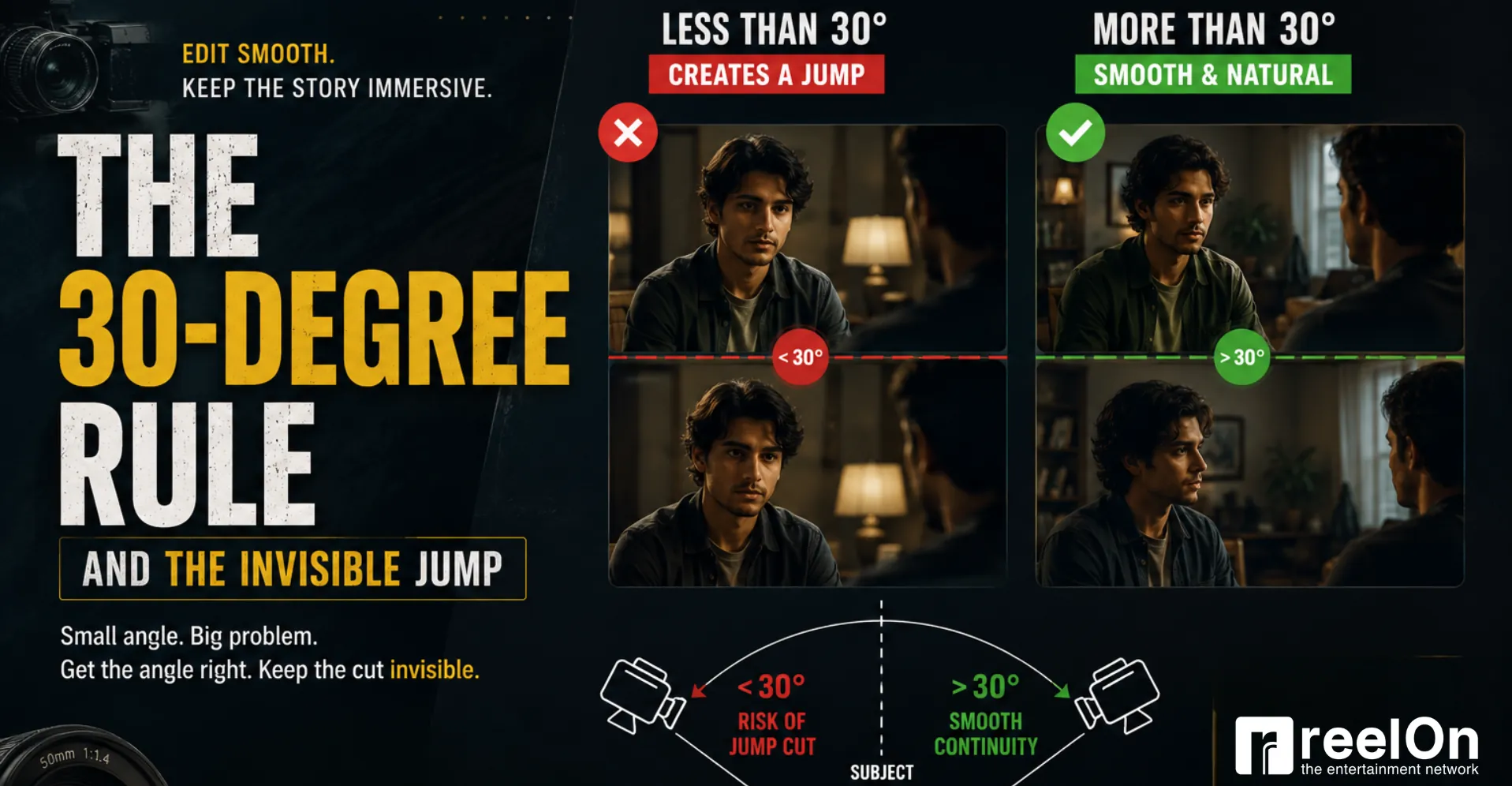
The 30-Degree Rule: The Invisible Jump You Should Never Ignore
Have you ever watched a scene that looked almost right, but something about the edit felt strangely awkward?
The actors are performing well. The framing looks good. The story makes sense. Yet, when the edit cuts from one shot to another, your eyes immediately notice something is wrong.
That subtle disruption is often caused by one of the simplest principles in filmmaking: the 30-degree rule.
It may sound like a technical cinematography concept, but it is really about one thing—keeping the audience immersed in the story.
What Is the 30-Degree Rule?
The 30-degree rule states that when cutting between two shots of the same subject, the camera should move at least approximately 30 degrees around that subject.
Why?
Because when the camera moves only a small amount, the subject appears to jump or stutter between shots. Instead of feeling like a natural change in perspective, the cut suddenly becomes visible.
The audience may not consciously think, “That camera only moved 15 degrees.” They simply feel that something is off.
And once the audience starts noticing the edit, you've momentarily taken them out of the story.
The Biggest Misunderstanding
One of the most common mistakes is assuming that changing the shot size is enough.
For example, you might cut from a medium shot to a close-up of the same actor. The framing is clearly different, but if both cameras are positioned almost at the same angle, the cut can still feel like a visual jump.
The important difference isn't just how close the camera is.
It is where the camera is positioned.
Think of camera angle as the geometry connecting one shot to the next. A meaningful change in perspective gives the viewer a reason to accept the cut.
How Filmmakers Use the Rule
During pre-production, mark the approximate camera angles on your shot list or scene diagram. When two consecutive shots feature the same subject, check whether the camera has moved enough to create a meaningful change in perspective.
But what if you want to move from a medium shot to a close-up without changing the angle?
That's where cutaways become useful.
A cutaway to another character, an object, a reaction, or another detail can reset the visual continuity. When you return to the original subject, the closer framing feels much more natural.
This is one of the many ways professional editing hides its own mechanics.
Learn to See Invisible Editing
A great exercise is to watch three scenes from films you consider visually seamless. Pause after every cut and ask:
“What actually changed between these two shots?”
Look at the camera angle, subject position, framing, movement, and eyeline.
You'll start noticing that good editing isn't simply about cutting at the right moment. It is also about understanding visual geometry.
For aspiring filmmakers, actors, editors, and creators, studying these principles can make a major difference. Platforms like reelOn can also help talent stay connected with auditions, projects, and opportunities across the entertainment industry—giving creators a chance to move from learning filmmaking concepts to experiencing the industry practically.
The Bottom Line
Invisible editing isn't accidental.
It is the result of hundreds of small decisions—camera placement, framing, movement, eyelines, and timing—working together without calling attention to themselves.
The 30-degree rule is one of those invisible tools.
When the audience notices your edit, they stop watching the story. When the edit disappears, the story takes over.
Master the geometry, and you can make your cuts feel effortless.
Frequently Asked Questions
1. What is the 30-degree rule?
The 30-degree rule suggests that when cutting between two shots of the same subject, the camera should change position by roughly 30 degrees or more to avoid a distracting visual jump.
2. Does changing shot size prevent a jump cut?
Not necessarily. Moving from a medium shot to a close-up may still feel awkward if the camera angle remains almost identical.
The subject can appear to jump or shift unnaturally between shots, drawing attention to the edit.
4. Can filmmakers intentionally break the 30-degree rule?
Yes. Like many filmmaking principles, it can be intentionally broken for stylistic effect, tension, discomfort, or to make the edit noticeable.
5. How can aspiring filmmakers practice this rule?
Shoot the same subject from multiple angles and gradually increase the camera movement between shots. Edit the footage together and compare which cuts feel smoothest.
6. How does reelOn help aspiring filmmakers and creators?
reelOn helps connect talent with entertainment opportunities such as auditions and projects, allowing aspiring creators and performers to move beyond learning and explore real industry opportunities.

